
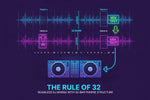
What Is the Rule of 32 in DJing?
, by Marcus Fitzpatrick, 3 min reading time
, by Marcus Fitzpatrick, 3 min reading time
If you want your mixes to sound intentional rather than accidental, you need to understand the rule of 32. It’s one of those fundamentals that separates DJs who hope a transition works from DJs who know it will.
Let’s break it down properly.
The rule of 32 is a phrase-based mixing guideline used in DJing. Most electronic and dance music is structured in phrases of 32 beats (also called a 32-count).
Music changes naturally at the end of these 32-beat phrases. That’s when:
Mixing at these points makes transitions sound clean and musical.
Ignore them, and your mix will sound forced — even if the BPMs are matched perfectly.
Beatmatching alone is not enough anymore. Anyone with modern DJing software can sync tempos. What most beginners get wrong is timing.
If you bring in a new track halfway through a phrase:
Follow the rule of 32 and your transitions will:
This is why experienced DJs can mix effortlessly on minimal DJ equipment — they understand structure, not just tools.
You don’t need to overthink this.
Most DJs count in groups of 8:
After enough practice, you won’t count consciously. You’ll feel it.
Here’s how DJs actually use it in the booth:
Most club-ready tracks are built with this exact structure because producers expect DJs to mix this way.
Short answer: No, but mostly yes.
It works best with:
Genres like hip-hop, open-format, or older disco can be less rigid. In those cases, phrasing still matters, but you’ll rely more on musical cues than strict counting.
Here’s the reality: waveforms, grids, and phrase markers make this easier than ever.
Most modern DJing software:
That doesn’t mean you should rely on visuals alone. If your laptop dies or grids are off, your ears and phrasing knowledge are what save the set.
Technology assists — it doesn’t replace fundamentals.
Let’s be blunt:
If your mixes sound messy, this is usually the reason.
The rule of 32 isn’t a “rule” in the strict sense — it’s how most dance music is built. Learn it, respect it, and your mixes will immediately sound tighter, more musical, and more confident.
Master this, and even basic DJ equipment becomes enough to deliver professional-level transitions.
Ignore it, and no amount of expensive gear or flashy effects will save your mix.